Safe phishing simulations show who would fall for a real attack. Three-minute lessons fix what each person got wrong. One security score tells management whether it is working.
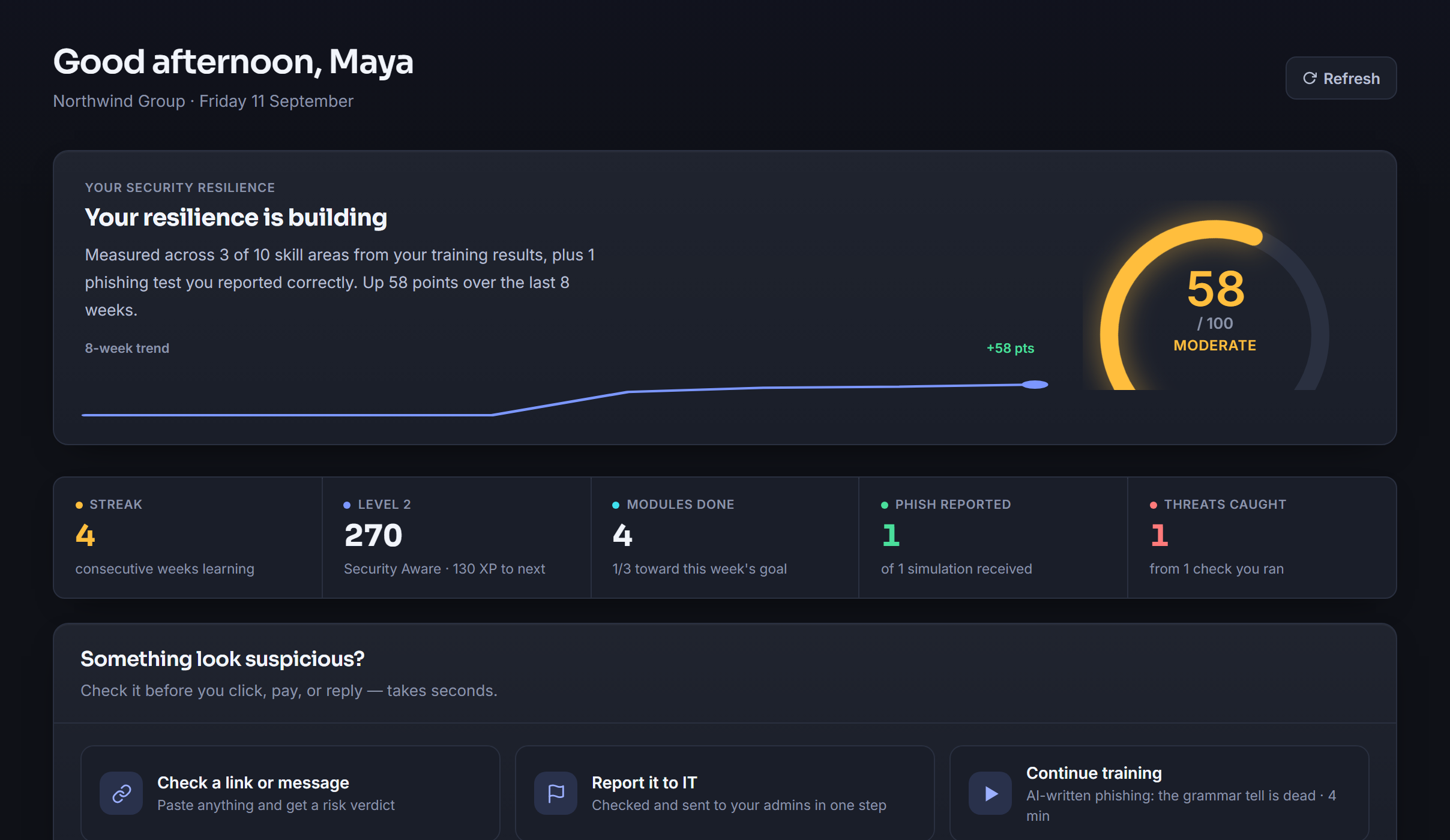
A working copy of the dashboard with sample data. Find the riskiest team, launch a simulation, then switch to the employee view and try to catch the phish yourself.
Sample data for a fictional company, Northwind Group. Nothing you do here is saved or sent anywhere.
Most breaches don't start with a hacked server — they start with one employee clicking one link. Traditional security tools can't see that, and most companies have no way to measure it until it's too late.
is all most breaches need. The usual way in is a convincing email to one person, not a flaw in your systems.
visibility most management teams have into which employees or departments are most vulnerable — until an incident forces the question.
a year is how often the average employee receives security awareness training — nowhere near enough to build lasting habits against evolving scams.

Every employee gets their own resilience score, a streak worth keeping, and short modules chosen from what they personally got wrong — not a yearly compliance deck nobody remembers.
A loop that runs all year, not a course people click through once. Each round shows what improved and what to work on next.
A first, safe simulation shows how each team responds today, so you know where to start instead of training everyone on everything.
When an employee encounters risky content or fails a simulation, they get a short, targeted lesson — not a 40-slide compliance deck.
Run authorized, safe phishing simulations to see who clicks, who reports, and where your organization's real gaps are.
A single CyberWatch AI Security Score gives management a clear, trackable number — with the detail to back it up.
Built for the person who has to make security training happen, and for the management team that wants to know it is working.
Templates based on the scams your people actually get: fake invoices, password resets, delivery notices, a message from the boss. Every one is safe and clearly marked afterwards.
Someone who clicks gets a three-minute lesson on exactly the tell they missed, straight away, while it still means something.
See which teams click, which report and which are improving, so you put the effort where the risk is.
A monthly report and one security score your board can follow over time, with the detail behind it when they ask.
Invite people by email, group them into departments and schedule a campaign in minutes. No email-system integration to set up.
Leaderboards are anonymous by default and the point is learning, not blame. Nobody is named to the whole company for one click.
Training teaches your people to spot a phishing email. Email Incident Response gives them one step to report the one that gets through, and your team one place to deal with it.
Book a short demo and we will run a real simulation with one of your departments, or start with a free assessment of your organization's risk.